

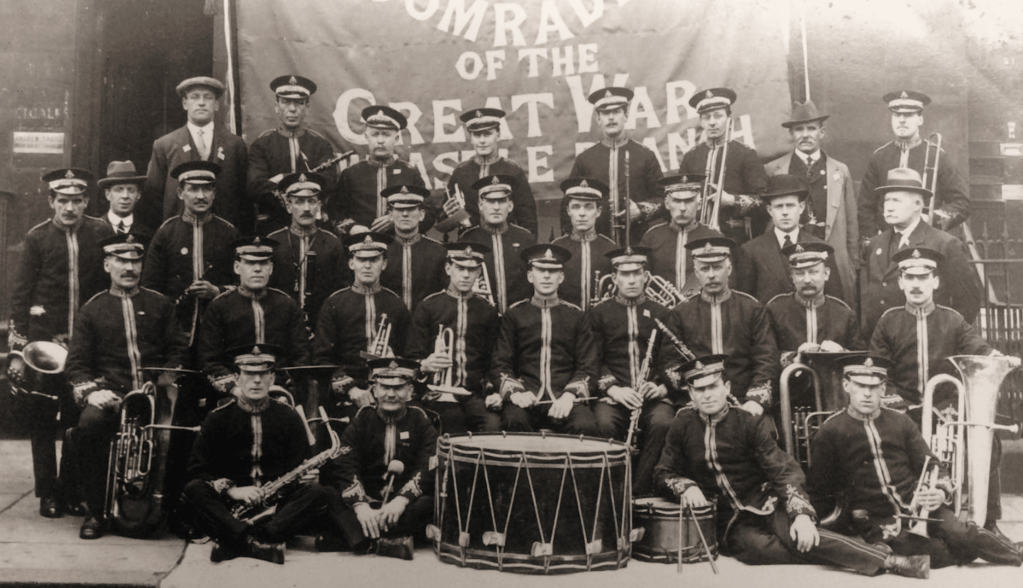
For reasons which may or may not become clear, I have recently become interested in the Newcastle Corporation Tramways Band. Here they are in 1910 in the rather fetching double breasted uniforms of the Tramways Undertaking. We tend to think of collieries as the main sponsors of brass bands, but in the late Victorian and Edwardian periods an extraordinary range of workplaces, schools, churches and political organisations boasted their own band. Often bands were sponsored by employers, who considered them a good way of encouraging temperance and rational recreation amongst their employees – making music, rather than getting wrecked in the pub every night. Gavin Holman lists almost 20,000 individual brass bands operating in the period across the UK. His entry for Newcastle alone shows not just church and military bands, but also bands associated with the police, the LNER Railways, the Locomotive works, the ‘Foresters’ and ‘Gardeners’, Industrial Engineers (including juvenile bands), the ‘Ragged and Industrial Schools,’ the workhouse, and of course the Tramways. By 1919 even the local branch of the ‘Comrades of the Great War’ (the veterans organisation established as a more conservative alternative to the rather radical NFDDSS) boasted its own band. Perhaps one can imagine some of the tramwaymen of this 1910 picture, now older and marked with the weariness of war, gazing out of the later 1919 picture of the ‘Comrades’ band? Is that rather square-jawed cornet player in the single-breasted tunic (indicating an inspector’s role) on the front row of the 1910 picture the same individual as the 1919 Comrade’s cornet player lying on the ground on the right hand end of the front row? My research is full of such fruitless speculation.
It seems that in the early days there was some uncertainty as to how closely the band should be supported by the Tramways Undertaking, either directly or in kind. In the UK the majority of Tramway operations had become municipalised by 1905. That is to say, they were run by the City Council, and the profits (for there were handsome profits) were reinvested in the tramways themselves, or else diverted towards keeping the Rates as low as possible. The minutes of the Newcastle Tramways Committee of the city council survive in the Tyne and Wear Archives Service, and these delightful records have been my constant study in the past few years.1 Members of the Tramways Committee were remarkably consistent over the years, and very powerful. I like to think that a non-partisan issue like supporting the Tramways Band gives a good insight into their characters – the kinds of people they were and the sort of society they wanted.
The first mention of the band in the minutes comes shortly after its inception. On 10th of October 1907 there is a request for direct financial assistance in setting up the band. The committee declared themselves to be ‘of the opinion that the movement is a very desirable one’, and agreed to authorise a one off contribution of £25.
It was only eight months before a further request was made on 4th June 1908 – this time for indirect help. The band was getting gigs and was keen to ensure that they could get time off to perform – they were after all representing the Tramways Undertaking, although Tramwaymen’s shift hours were brutally long in this period, much longer than those of other workers and this was already the focus of much dispute between the committee and the tramworker’s union. When they petitioned the committee to be ‘liberated from their duties’ in order to play for the opening of a ‘Model Cottage Exhibition’, the committee evidently sensed a vexatious string of similar requests stretching into the future. A debate ensued about whether to retain control by insisting that all future such requests come before the committee itself, or whether to deputise that function to the Band secretary. Eventually it was agreed to allow the Band secretary to make such decisions, although it’s noticeable that a third of the committee were most reluctant to relinquish this power. Perhaps they saw trouble ahead if the band became too successful?
In November 1908 a more significant issue arose – the Band secretary asked for a meeting to discuss the possibility that the corporation might pay for the purchase of instruments. With admirable caution, the committee decided to ask around to see what happened in other municipalities and in early 1909 the general manager
submitted correspondence which he had had with other tramways owning Corporations as to contributions towards Tramways Bands, from which it appeared that contributions had been made in Salford, Sheffield (£25) and Liverpool (Instruments purchased by Committee); that the Birmingham and Brandford bands were self-supporting; and that at Manchester & Nottingham bands had not been established.
Evidently this 3/2 split was enough to encourage the committee (on a motion submitted by J.H. Rodgers), to refuse the band any assistance.
But the instrument question did not go away. The band held several concerts in the next two years to raise funds to buy instruments, but by November 1910 they had returned to the committee with a request that they put up £150 to buy instruments to be held in trust until such time as the band members could raise money to buy them. The committee refused.
It’s not really clear what happened next. The minutes are silent on the matter, but the band must have somehow contrived to borrow the money from somewhere (relatively standard practice for bands at this point), and then got into trouble servicing their debt, for the next mention of the matter is two years later on 29th August 1912 when, in response to an appeal by the secretary of the Tramways band, the Tramway committee finally agrees to pay £125 specifically to clear the debt incurred by the band. In return, the instruments of the band ‘shall be held by the Committee as security, and they shall not at any time be disposed of without the Committee’s consent.’
Perhaps even a few paragraphs ago you have already been thinking ‘jfc, Lawrence has really lost his grip on reality if he thinks we are the least bit interested in this level of minutiae about these petty disputes from over 100 years ago. Of all the dorky rabbit holes he’s led us down, this is surely the dorkiest’ – and I’d be inclined to agree with you. But this is the moment at which the band hits the newspapers.
The Newcastle Daily Chronicle is the first to report on the matter on 30th August 1912, and its report is much the most detailed:
Newcastle Tramways Band
A meeting of the Tramways Committee of the Newcastle Corporation was held yesterday, Councillor J.H. Rodgers presiding.
A letter was read by the chairman from the Secretary of the Tramways Band Committee, intimating that £125 was still owing on their instruments, and asking the Committee to assist them, as the debt must be paid by the end of the present month.
It was decided to pay this amount, on condition that the instruments became the property of the Tramways Committee.
It was stated that the instruments cost over £400, all of which had been paid by the men except the £125.
On 2nd September 1912 the story is taken up in a shorter form, perhaps rather randomly, by the Halifax Evening Courier:
As members of the Newcastle Tramways Band have been unable to pay off the debt on their instruments, the tramways committee of the corporation have decided to find the money on condition that the instruments are considered municipal property.
Over the next week this exact sentence appears seventeen times, in sixteen different newspapers. It appears in the Daily Express, the Yorkshire Evening Post, Lincolnshire Chronicle and the Bolton Evening News in addition to the Halifax Evening Courier on 2nd September. On 3rd September it appears in the Daily Herald, Exeter and Plymouth Gazette, Hull Daily Mail, Edinburgh Evening News, Halifax Daily Guardian and the Daily Gazette for Middlesbrough. On 4th September it appears in the Belfast News-Letter and in the Preston Herald. On 6th September it appears in the St Helen’s Reporter, Ashbourne News Telegraph, Musselburgh News, The Mid-Lothian Journal and the Alfreton Journal. On the 7th September it appears in the Kilkenny Moderator and again in the Preston Herald.
Why? The story is hardly clickbait. One explanation has of course to do with the structures of the Edwardian newspaper industry – the story had been picked up and nationally syndicated, presumably by one of the big news agencies. It appears each time in columns devoted to similar tiny snippets and titbits of news – arresting stories such as that of a man who fell off Waterloo Bridge attempting to catch papers that had been caught in the breeze (also Daily Express 2/9/1912, Edinburgh Evening News 3/9/1912), or of an ill man whose workmates at Dennis Brothers’ Motor Factories worked overtime to pay for his medical care (also Edinburgh Evening News 3/9/1912, Ashburn News Telegraph 6/9/1912, Alfreton Journal 6/9/1912), or (in exactly those papers again) of a man who died aged 71 at St Pancras despite having pleurisy for forty years. Newspapers of the period abounded in such tiny little snippets – tasters of stories from around the country which never got full coverage but filled the closely printed columns with content – a diverting micro narrative form which perhaps demonstrates that the TikTok reel is nothing new.
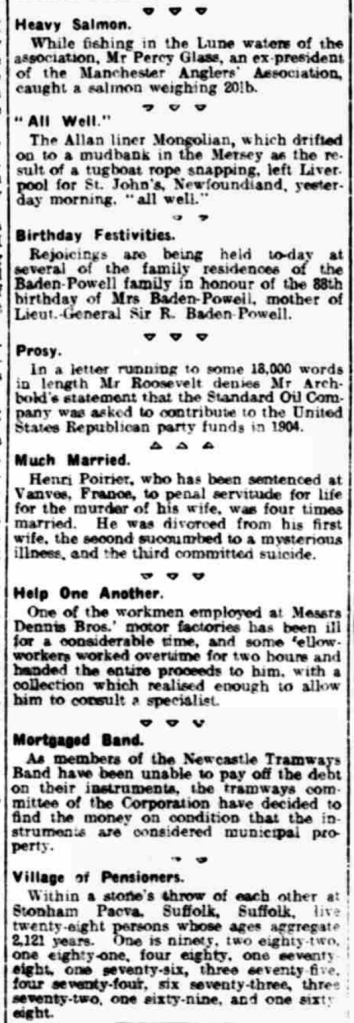
But still – why? Why was this story taken up? It hardly has the human interest qualities of its companions – there is no death, no heartwarming act of comradeship or Darwin Awards style foolishness. It’s not even novel – as we’ve seen, the Liverpool Tramways Committee had already bought their band’s instruments without controversy. The only solution I can suggest is in the introduction of the word municipal into the shorter version of the story. Municipalisation was a live and controversial topic in this period – The Fabian Society had campaigned for it in their early tracts at the turn of the century, George Bernard Shaw came out in favour of it in his pamphlet of 1904, and American economists looked on with horror as the efficient electrification and large profits of UK tramways run by local councils offered clear arguments for the further municipalisation of gas, water, education and lighting.2 Perhaps the novelty of the idea of brass band instruments as municipal property tickled the editors at the news agencies.
The Newcastle Tramways Committee wasn’t so tickled though. Such concessions to the frivolity of bandsmen were not to be repeated. When on 27th March 1913 the Parks and Gardens Committee communicated their desire that bandsmen on their way to play in Sunday entertainments in parks should be allowed to take their large bass instruments on the trams while only paying a standard single fare, the request was dismissed out of hand.
- The Tramways Committee is a subcommittee of the Traffic, Highways and Transport Committee. The relevant minute books can be found in TWAS catalogue in the series MD.NC/266/1-6 ↩︎
- Fabian Tracts Nos 30-34 ‘The Fabian Municipal Program’ included essays dealing with the municipalization of the Gas Supply, Tramways, Water, and London’s Docks. (London: The Fabian Society, 1898-1900); George Bernard Shaw, The Common Sense of Municopal Trading (Westminster: Archibald Constable & Co Ltd, 1904; Hugo Richard Meyer, Municipal Ownership in Great Britain (New York: Macmillan, 1906). ↩︎
NB – If you’d really like to follow me down this rabbit hole, I’m giving a talk on the Newcastle Tramways Committee at the Common Room (the Newcastle Mining Engineers Institute) on 18th September 2025
 At the Pictures